
i enjoyed learning about the origins of Japan, which are traced back to the Yayoi period, where there was a significant influence of immigration from Korea. The country was inhabited with hunter-gatherers for thousands of years, before a unique surge of culture took place. During the Paleolithic era, the upper west influenced northeastern Asia, shaping the diet, tools, pottery, and trading practices in that region. The Ryukyu region in S. Japan holds the oldest evidence of human bones/tools, while bones have also been discovered under volcanoes in Kyushu. The Jomon period saw the spread of woodlands and a warmer climate, leading to an increase in food and animals to hunt. N. Japan relied heavily on river salmon and developed cooking pots, ceramic containers to store food, pit houses, and communal longhouses for storage; burnished pottery, ceramic teapots, and pottery drums were used in feasts and celebrations. During this period, there were more communities and social influences, which led to the introduction of ancient fishing and rice paddy fields by Korean immigrants in S. Japan. This resulted in competition between families, given the different graves and crops found in that region. The Yayoi period involved a majority of Japanese and Korean families who spread quickly throughout Japan. The peak of the Yayoi period was in Yoshinogini, which may have been the capital. The Kofun period saw the rise of aristocrats, who shared their ways of control and gaining wealth through the housing and goods they possessed. This period was marked by combat and housing completions, estimate from the findings of war horses, armor, and weapons. The Chinese concepts of court hierarchy with official ranks and governors, road systems, population registers, and taxing, inspired the social and political system of Japan. In 646 CE, the Yamato court edict was issued and this eventually evolved into a centralized imperial state by 710 CE, during the Nihon period.
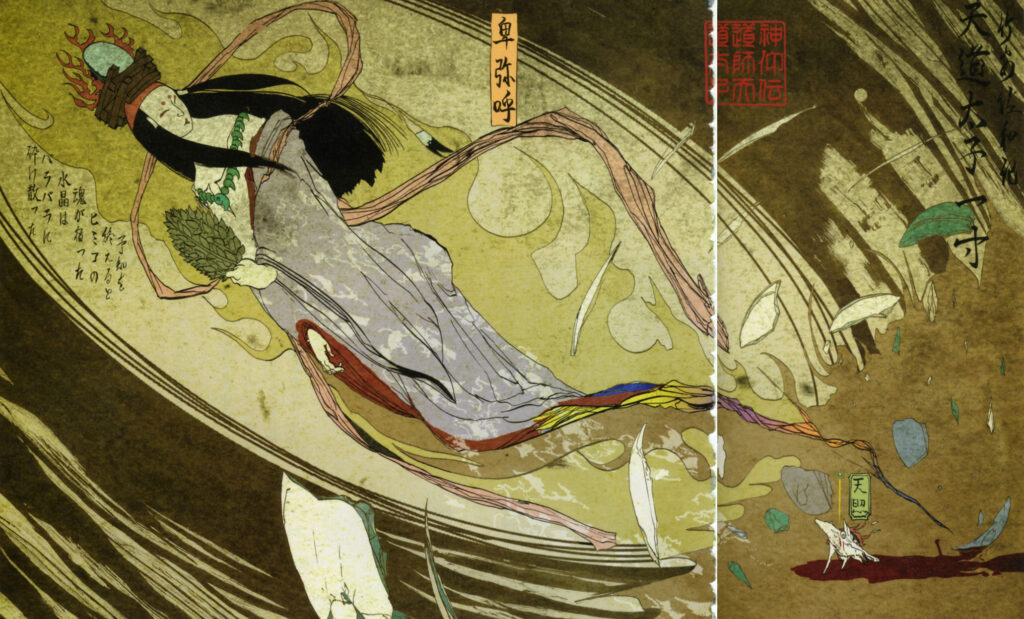
To understand and learn how to differentiate well-written and reliable articles and source material, the class was divided into various groups that had different articles about Queen Himiko. I learned and found very interesting how Queen Himiko was a legendary figure in ancient Japan who was believed to be a divine descendant of the Shinto sun goddess, Amaterasu. She was the ruler of the Yamato territory, one of the 100+ kingdoms in Japan, and was considered the most powerful. She was referred to as the “ruler of all Japan”, according to the Wa in China and had a good relationship with the Wei dynasty. Her rule was recorded in Chinese sources such as the Wei Chih history book, and it was believed that she was chosen by the people to rule after 80 years of warfare and uprisings. It was said that she lived a secluded life, serving as a high priestess and shaman, and was attended by 1000 women in her fortress. Her legacy in Japan continues to live on through references in tarot cards, manga, pageants, and as a well-known historical figure in schools. I think people who encounter Queen Himiko first in this context perceive her honestly as a badass ruler, but without learning her historical impact and significance (for example learning about her through tarot cards) it is a completely different interpretation because of how over-glorified she is (I do not mean this negatively). The exact location of her rule and the details of her ruling and burial are debated, but her tomb is believed to be a 150 meter mound with 100 slave sacrifices and dates back to the Yayoi through to the Kofun period (250-538 CE). Although the article was extremely short and vague, it was a good source in order to get a quick introduction to who Queen Himiko was.
I added more to this post, responding to this comment: “How do you think people who encounter Queen Himiko first in this context perceive her? We can learn all these great and inspiring things about her but how do you think that is different from say tarot cards?”. Through rewriting this, I learned to think about different perspectives on understanding influential figures that are adapted into pop culture and media. 👍