EC intoduce an image

For this extra credit image, I wanted to find another example of a woodblock print with a haiku. Last semester I took the printmaking introduction course, which introduced me to woodblock and linoleum (linocut) prints. It is a tedious and time-consuming process, but worth it in the end. Seeing the art that you took the time to intricately carve out (backwards) is worthwhile and rewarding. I admire haiku poetry and traditional woodblock prints, or ukiyo-e; when they are combined, the results are incredible. The minimalist form of poetry, Haiku, and woodblock printmaking originated during the 17th century. The prints were primarily used for ads and entertainment, but also an important medium of expression for artists. These two mediums of art, poetry, and printmaking, create such an impressive way of capturing the nature of being in the present and fleeting moments (i.e. describing a bird flying, a leaf flying, someone drinking tea, enjoying simple things). This combination reveals the beauty and importance of living in the moment and appreciating the small things in life, as it incorporates a short impactful haiku poem and a pretty visual to have along with it; it truly brings out the meaning of the art piece to life. Although this art form looks so simple, it takes a lot of time, thought, and effort to create and in the end, forms a deep connection with nature and art. Many scenes depict natural life every day in Edo, Japan: like sakura trees blossoming, snowy mountains, pretty landscapes, flowers, animals, the beauty/peace nature produces, theater actors, poses of women, and a wide range of people (including middle-class citizens and samurai’s— sold at low prices to appeal to not just upper-class people), and Japanese mythology. Through these scenes, deep emotions and feelings are simplified into a small poem and captivated by the woodblock print. “Japanese woodblock prints typically featured vibrant colors and were created using multiple blocks.  A master artist would create the key block, and a team of assistants would then cut a block for each color used in the print.”. The woodblock print below is by Utagawa(Ando) Hiroshige, who was born in 1797 and died in 1858. He is the son of Ando Genemon, an official firefighter and a part of the class of samurai. Instead of pursuing this occupation, he decided to create woodblock prints and was very successful with his portrayals of everyday landscapes and “Famous Places of the Eastern Capital”, which he produced under a different name (幽斎(Ichiyusai)). After the popularity of these pieces, he decided to focus his attention on post towns, travelers, Mt. Fuji, and a series called “Fifty-Three Stages on the Tokaido”. The name of the woodblock print with ink and color on the paper below is Shiba Atogayama (Mount Atago in Shiba) from the series “Famous Places in Edo” made during the Edo period (10 x 14.5 in.) in Tokyo, Japan, by Utagawa Hiroshige. This scenery is a view of Atogoyama Hill in the Shiba district of Edo, which is now Tokyo. There are temples and buildings, surrounded by people, animals, and trees. The use of color for the structures and nature/sky is visually appealing, as it is made up of light yellow and bright yellow, and blues/greens. It gives off the vibes of a soft dreamy-like perspective. In the center of this print is a large tree in the foreground, along with smaller trees and people (giving it depth and drawing the viewer to look deeper into this piece). I couldn’t find a description or analysis of this print, but this was a popular place, given it is a part of the series and the number of people there, for either locals or even tourists. It seems like an enjoyable place to walk around and admire the architecture. I am not sure what the Japanese characters say on the left and toward the center, but I am pretty sure on the right is his signature ? Regardless, this piece is still very magical on its own and I’m glad I found this 🙂
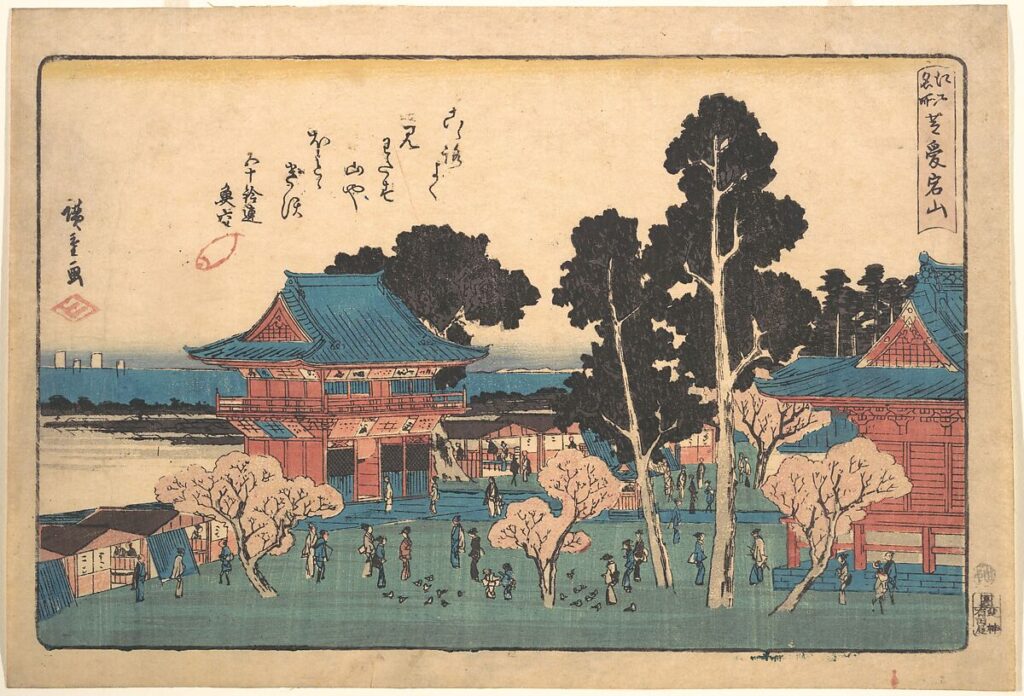
scenery of Mount Atago in Shiba, Japan, with the use of soft colors of yellow, red, blue, and green. There are trees at the center, surrounded by people for the perspective and depth. There are also temples and small buildings (which are red and blue). The sjy is yellow.

source

“Haiku and Ukiyo-e.” Haiku & Ukiyo-e | Museum of Art | Bates College, 15 Apr. 2010, www.bates.edu/museum/education/thousandwordproject/lesson-plans/katherine-cargile-lewiston-middle-school-haiku-and-ukiyo-e.
“Haiku and Ukiyo-e.” Haiku & Ukiyo-e | Museum of Art | Bates College, 15 Apr. 2010, www.bates.edu/museum/education/thousandwordproject/lesson-plans/katherine-cargile-lewiston-middle-school-haiku-and-ukiyo-e.
Down the Rabbit Hole: Battle of Sekigahara

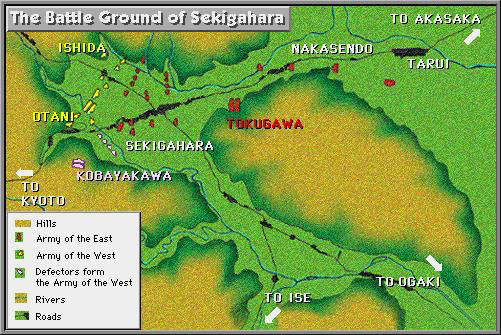
To go down this rabbit hole🕳️ 🐇, I am going to elaborate on Tokugawa Ieyasu’s crazy strict control and intimidating tactics that gained him power during a time of political instability in Japan. He was pretty intense and a tactic of his was utilized through The Battle of Sekigahara on October 21, 1600, where trained musketeers used firearms in a strategically lined formation one after the other. This battle was significant in the fact that he was able to distinguish his power as the new shogun that would unify Japan. His need for absolute power consumed him and he used powerful individuals with a strong military background, generals (like li Naomasa), and allying with notable families: Kato, Hosokawa, and Kuroda. Along with these fierce forces, Ieyasu created an “Army of the East”, with support from his Matsudaira family and a network of spies. This gave him the advantage to attack Ishida’s defenses, and as soon as Ishida found this out he retreated, which ironically was exactly what Ieyasu expected. Despite the rain all through the night, after it cleared up, he used a vanguard of musketeers that crushed the Western’s defensive line at 8 am and then at noon The Easterners were going to attack, but because of his spies, they formed an alliance with the Kobayakawa family and defeated the East. As an act of true integrity towards this battle, Otani (the commander of the South for the Westerners), split his stomach open in “the ritual manner”. Now that the Southern force was down, only Shimazu, the general, was left and he charged through the center of the Easterners forces by confusing Ieyasu by changing helmets and leading 200 troops to attack. Even so, they were still defeated (Shimazu and 80 men escaped), and Ishida, a commander, and leaders of the Westerners were captured. After this gruesome battle, Tokugawa Ieyasu became a shogun.

battle ground picture of the battle of sekigahara, showing hills, the armies, defensive, rivers, roads, and where tokugawa is at some point.

source

“Japan Emerging: Premodern History to 1850.”, edited by Karl F. Friday. New York, NY: Routledge, 2018.

The Story of the Battle of Sekigahara. www.nakasendoway.com/the-story-of-the-battle-of-sekigahara.

week 13 (with footnote)

Tokugawa Ieyasu (1543-1616) was a retainer shōgun, who had strict control/ intimidating tactics and gained power during a time of political instability in Japan, by being chosen as one of the five to balance out the lack of a new emperor (since the son next in line was too young) and as he had tried to restore unity and order in Japan. For example on how achieved intimidating authority and control was the succession of The Battle of Sekigahara, where trained musketeers used firearms in a strategic lined formation one after the other. After this win, he banned and hid away these weapons, in order for there to be no way they can be used against him. Terrified and paranoid of assassination and loosing his power, Tokugawa retreated and hid away, essentially, to the tower of Edo Castle that he created, making it impenetrable. His design incorporated very few entry points and various waterways surrounding the inner areas; the country was made up of a network of strictly confined and lightly populated provinces (Mikawa, Tōtōmi, Suruga, Shinano, and Kai), managed and controlled by lords and samurai. This was his idea of controlling people and preventing attacks and rebels (making sure they cannot organize against him), while also restricting when and where people can go, which made it difficult to gather resources to fight back. There was also no marriages or relations with other provinces, thwarting any possibly of alliances nor time to even think about rebelling; every six months everyone in the provinces were forced to spend half of their year performing service at the palace. Each province travelled to the castle, in order to handle their affairs, in a specific way, according to their status; the wife/children stayed at Edo castle and went their separate ways from the rest of their family, having to live apart and wait for service to end. The journey to the castle consisted of various parades of samurai and people traveling back and forth ( but no matter what, there was always someone at Edo to make sure everyone was behaving and doing their tasks) and if someone tried to rebel, they would be killed, along with the wife and children waiting in the castle. Created a road and bridges network of five. Tokugawa’s rule was characterized by extreme strict control and a strong desire to maintain his power. He was worried and paranoid about assassination and rebellion, which led him to take extreme measures to prevent anyone from challenging him. While his tactics were effective in maintaining stability, they also restricted people’s freedom and prevented the development of more democratic forms of government, which had many negative effects on Japan. Although it prevented civil war and rebellion, his tactics were highly restrictive and controlling, limiting freedom and opportunities for a sense of control and meaning in people’s lives (and pursuing their own goals and career paths). This led to a lack of cultural and economic growth; the lack of social mobility and limited opportunities for people in the lower classes prompted Japan to have a slow lack of progress and contributing to the global economy, compared to other nations. The fear the Japanese felt toward Christianity is reflected in the renunciation of the Christian faith reproduced in Document 16.

Regarding incoming foreigners, who have dangerous weapons and christian faith overwhelmed Tokugawa and he forced to get rid of any sense of these things. Christians used to be okay because it was new to them, but now things became gruesome, as they were thrown in pits of fire and their ashes were scattered in the sea. Christians became very disliked and this led to murder and the sea even needed to be purified. Not all foreigners were banned (mostly christian’s); the Dutch stayed because they disliked the british and christian’s, and said they were interested in making money. One head man was appointed to be held accountable for the Dutch as a whole. They reported to the shogun in Edo once a year and everyone else has to stay on the island. During this time, no japanese were allowed off of islands to travel until the 1850’s, although things were still imported: phrase books to learn dutch, anatomy, medicine, and astronomy . The decision to close the country was set in place in order to gain stability and peace that Tokugawa sought. The prohibition of Japanese ships to trade overseas in Document 13 eliminated competition against the Dutch trade. The policy of seclusion1 (closed country) from 1633 to 1853 was mainly driven by the fear of Christianity and the desire to monopolize all the benefits from foreign trade (which the Dutch then took advantage of this by monopolizing trade).

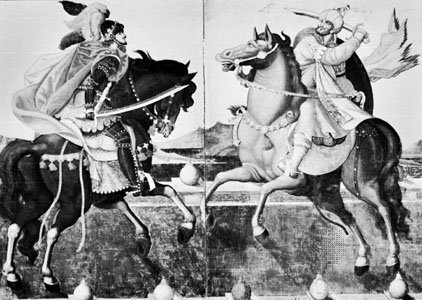
Xavier and the Western Princes on Horseback, two-panel detail of a four-panel byobu screen painting, colour and gold leaf on paper; in the Kōbe City Museum, Kōbe, Japan. Black and White.

Xavier and the Western Princes on Horseback [an example of how westerners were depicted by the Japanese] — I also touched upon this in my show and tell 4

Policy of Seclusion, or ‘sakoku’ is the Japanese term for closed country. The Japanese policy consisted of a series of directives implemented over several years during the Edo Period, or ‘Tokugawa period’ during 1603–1867, that enforced self-isolation from foreign powers in the early 17th century. Munez, Everett. “sakoku”. Encyclopedia Britannica, 18 Apr. 2023, https://www.britannica.com/topic/sakoku. Accessed 23 April 2023.

“Control of Vassals.” In David John Lu. Japan: A Documentary History, 203-208. Armonk, NY: M.E. Sharpe, 1997.

“Closing the Country.” In David John Lu. Japan: A Documentary History, 220-228. Armonk, NY: M.E. Sharpe, 1997.

“Japan Emerging: Premodern History to 1850.”, edited by Karl F. Friday. New York, NY: Routledge, 2018.

extra credit image- footnote

source

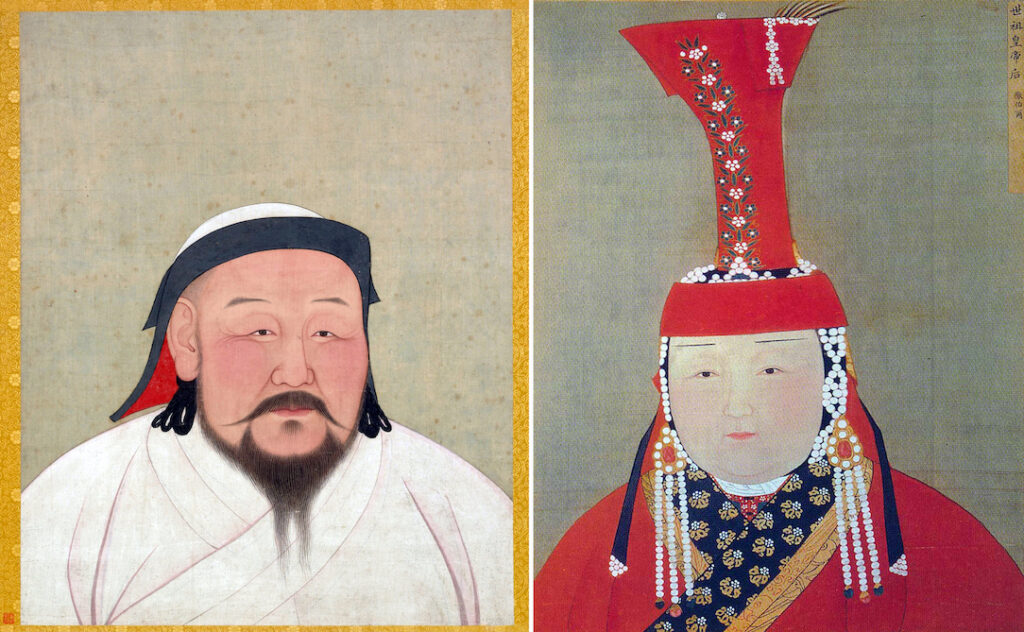
This image is a portrait painting of Kublai Khan (on the left) and his wife/empress, Chabi (on the right), from the Yuan dynasty. These portraits are both in the National Palace Museum in Taibei and created in 1294 by an artist, Anige, from Nepali and a part of Kublai Khan’s court. They are painted with colored ink on silk in a mixture of traditional Chinese (imperial portraiture) and Nepali art styles. The Mongols held the traditional Chinese and Nepali, Himalayan art style in high esteem and value in order to represent them as successors of the Han Chinese emperors. Kublai Khan was fascinated by Buddhism and had Anige design and create many art pieces, sculptures, and temples; after the Mongol invasion of China and the Song court being taken over, the Imperial Academy of Painting was put to an end so Anige was hired. Anige was an artist and architect that also goes by Araniko or Aniko. His most famous work is the White stupa at Miaoying Temple 1 in Beijing, which has “religious merit that contributed to Kublai’s military victory and other achievements”.

1 White stupa at Miaoying Temple: although this is the greatest work by Araniko, this also has historical significance as a peacemaker between Nepal and China. It was created during the Yuan Dynasty and has symmetry and architectural designing inspired by Buddhism (symbolizing stability). 姗娜 . “The White Stupa of the Miaoying Temple, Beijing.” Your Online Guide to Government Services in China, https://govt.chinadaily.com.cn/s/202204/13/WS62569414498e6a12c1229e2a/the-white-stupa-of-the-miaoying-temple-beijing.html#:~:text=The%20White%20Stupa%20of%20the%20Miaoying%20Temple%20was%20the%20greatest,friendship%20between%20China%20and%20Nepal. 

Chaffin, Cortney “Art under the Mongols”, https://smarthistory.org/reframing-art-history/art-under-the-mongols/. Smarthistory, March 26, 2023.

week 2 rewrite

i enjoyed learning about the origins of Japan, which are traced back to the Yayoi period, where there was a significant influence of immigration from Korea. The country was inhabited with hunter-gatherers for thousands of years, before a unique surge of culture took place. During the Paleolithic era, the upper west influenced northeastern Asia, shaping the diet, tools, pottery, and trading practices in that region. The Ryukyu region in S. Japan holds the oldest evidence of human bones/tools, while bones have also been discovered under volcanoes in Kyushu. The Jomon period saw the spread of woodlands and a warmer climate, leading to an increase in food and animals to hunt. N. Japan relied heavily on river salmon and developed cooking pots, ceramic containers to store food, pit houses, and communal longhouses for storage; burnished pottery, ceramic teapots, and pottery drums were used in feasts and celebrations. During this period, there were more communities and social influences, which led to the introduction of ancient fishing and rice paddy fields by Korean immigrants in S. Japan. This resulted in competition between families, given the different graves and crops found in that region. The Yayoi period involved a majority of Japanese and Korean families who spread quickly throughout Japan. The peak of the Yayoi period was in Yoshinogini, which may have been the capital. The Kofun period saw the rise of aristocrats, who shared their ways of control and gaining wealth through the housing and goods they possessed. This period was marked by combat and housing completions, estimate from the findings of war horses, armor, and weapons. The Chinese concepts of court hierarchy with official ranks and governors, road systems, population registers, and taxing, inspired the social and political system of Japan. In 646 CE, the Yamato court edict was issued and this eventually evolved into a centralized imperial state by 710 CE, during the Nihon period.

To understand and learn how to differentiate well-written and reliable articles and source material, the class was divided into various groups that had different articles about Queen Himiko. I learned and found very interesting how Queen Himiko was a legendary figure in ancient Japan who was believed to be a divine descendant of the Shinto sun goddess, Amaterasu. She was the ruler of the Yamato territory, one of the 100+ kingdoms in Japan, and was considered the most powerful. She was referred to as the “ruler of all Japan”, according to the Wa in China and had a good relationship with the Wei dynasty. Her rule was recorded in Chinese sources such as the Wei Chih history book, and it was believed that she was chosen by the people to rule after 80 years of warfare and uprisings. It was said that she lived a secluded life, serving as a high priestess and shaman, and was attended by 1000 women in her fortress. Her legacy in Japan continues to live on through references in tarot cards, manga, pageants, and as a well-known historical figure in schools. I think people who encounter Queen Himiko first in this context perceive her honestly as a badass ruler, but without learning her historical impact and significance (for example learning about her through tarot cards) it is a completely different interpretation because of how over-glorified she is (I do not mean this negatively). The exact location of her rule and the details of her ruling and burial are debated, but her tomb is believed to be a 150 meter mound with 100 slave sacrifices and dates back to the Yayoi through to the Kofun period (250-538 CE). Although the article was extremely short and vague, it was a good source in order to get a quick introduction to who Queen Himiko was.

I added more to this post, responding to this comment: “How do you think people who encounter Queen Himiko first in this context perceive her? We can learn all these great and inspiring things about her but how do you think that is different from say tarot cards?”. Through rewriting this, I learned to think about different perspectives on understanding influential figures that are adapted into pop culture and media. 👍

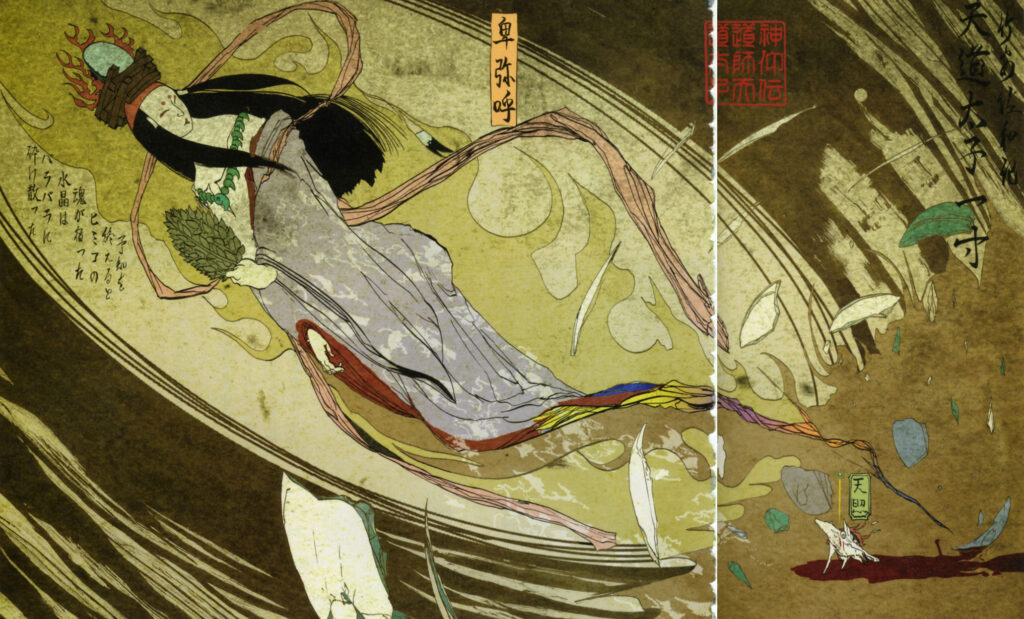
traditional japanese art style of queen himiko’s spirit leaving a crystal orb
source
css.php