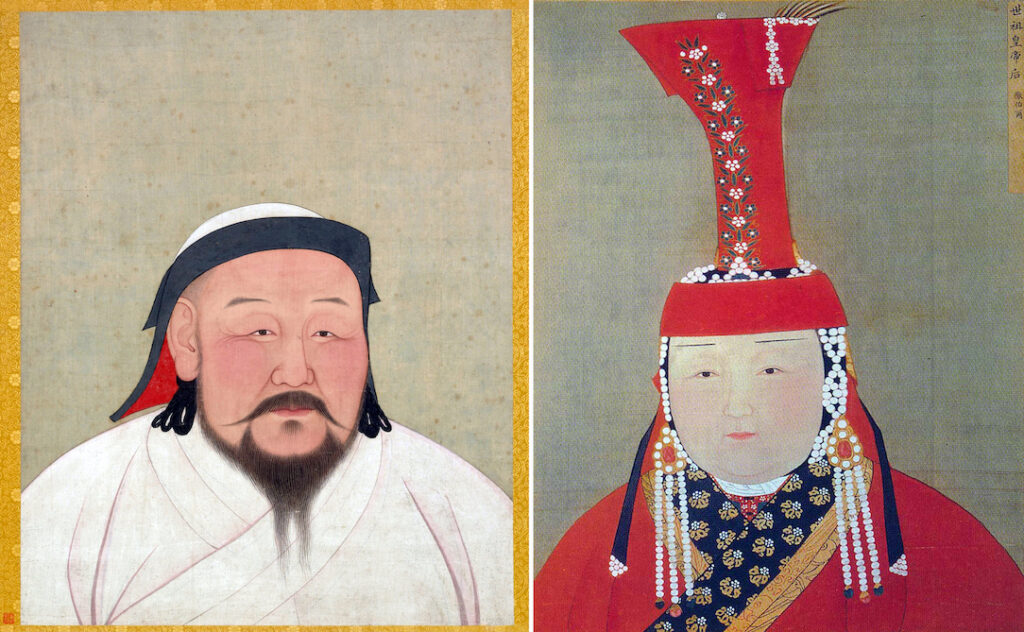
This image is a portrait painting of Kublai Khan (on the left) and his wife/empress, Chabi (on the right), from the Yuan dynasty. These portraits are both in the National Palace Museum in Taibei and created in 1294 by an artist, Anige, from Nepali and a part of Kublai Khan’s court. They are painted with colored ink on silk in a mixture of traditional Chinese (imperial portraiture) and Nepali art styles. The Mongols held the traditional Chinese and Nepali, Himalayan art style in high esteem and value in order to represent them as successors of the Han Chinese emperors. Kublai Khan was fascinated by Buddhism and had Anige design and create many art pieces, sculptures, and temples; after the Mongol invasion of China and the Song court being taken over, the Imperial Academy of Painting was put to an end so Anige was hired. Anige was an artist and architect that also goes by Araniko or Aniko. His most famous work is the White stupa at Miaoying Temple 1 in Beijing, which has “religious merit that contributed to Kublai’s military victory and other achievements”.
1White stupa at Miaoying Temple: although this is the greatest work by Araniko, this also has historical significance as a peacemaker between Nepal and China. It was created during the Yuan Dynasty and has symmetry and architectural designing inspired by Buddhism (symbolizing stability). 姗娜 . “The White Stupa of the Miaoying Temple, Beijing.” Your Online Guide to Government Services in China, https://govt.chinadaily.com.cn/s/202204/13/WS62569414498e6a12c1229e2a/the-white-stupa-of-the-miaoying-temple-beijing.html#:~:text=The%20White%20Stupa%20of%20the%20Miaoying%20Temple%20was%20the%20greatest,friendship%20between%20China%20and%20Nepal.
Chaffin, Cortney “Art under the Mongols”, https://smarthistory.org/reframing-art-history/art-under-the-mongols/. Smarthistory, March 26, 2023.
I wanted to focus on the epic poem, The Jetavana Temple. This song incorporates ideas about the short human life and the downside of power and wealth. It teaches the Buddhist ideal that all things will eventually change and die out. These lyrics are melancholy and I feel like you start to reflect on mortality. This begins describing the Jetavana Temple bells, which ring to mark the passing of all things. The image of the bells could be a type of reminder of our short lives and the inevitability of death. The twin sal trees, white in full flower, are used to symbolize the power of men, which is evidently brought to nothing by death. The song then describes different historical figures who were brought down by their own arrogance and pride (like for example, Zhao Gao of Qin, Wang Mang of Han, Zhu Yi of Liang, and Lushan of Tang). These individuals are compared with others who were more humble and wise and recognized how short life is, keeping in mind to not cling to material items. Taira no Kiyomori, who was a powerful nobleman and former official in Japan, accomplished many, and his lineage was traced back to a humble start. It’s emphasized that power and wealth was fleeting and how even the most powerful and wealthy people have the same fate as all living beings. The Jetavana Temple song is a strong reminder of our short lives and the importance of humility and wisdom in the face of impermanence. The song creates a sense of introspection and makes you reflect on your own mortality and the fleeting nature of human existence.
This overarching theme of impermanence is also found in the other reading we had, like in the sound of the Gion Shoja bells and the truth revealed by the fading color of the sakura flowers. This theme correlates with the Buddhist concept of impermanence and emphasizes the transience of life and worldly things. Another theme is the shift of power and wealth, like with the story of the Taira clan and their leader, Kiyomori. It focuses on how those who are proud and arrogant will eventually have a downfall. The dancers are envious towards Gio’s success and the spiteful comments made towards those who changed their names to include “Gi”, which highlights the negative effects of jealousy and resentment. There is also kindness in the story of Hotoke and her reception at Kiyomori’s house. It shows how it is important to have compassion and empathy towards others (especially towards those who are vulnerable or less fortunate).
Another theme is the power dynamics and gender roles during the Heian period. Sadly, there is no power that women had during this time period. Hotoke, a woman who was dismissed by Kiyomori, was called back to sing and dance for him and despite her reluctance, she was still forced to perform -_- It shows that Kiyomori had full control over the situation and the women involved. Also Gio, who was Kiyomori’s mistress, lost her position and was fired with absolutely no say in the matter. It was so sad that she grieved alone and had all that unwanted attention from other men. There were just very limited options available for women during the Heian period in Japan.
The Tale of the Heike, translated by Royall Tyler. New York: Viking, 2012.
Genji & Heike: Selections from The Tale of Genji and The Tale of Heike, translated by Helen Craig McCullough. Stanford: Stanford University Press, 1994.
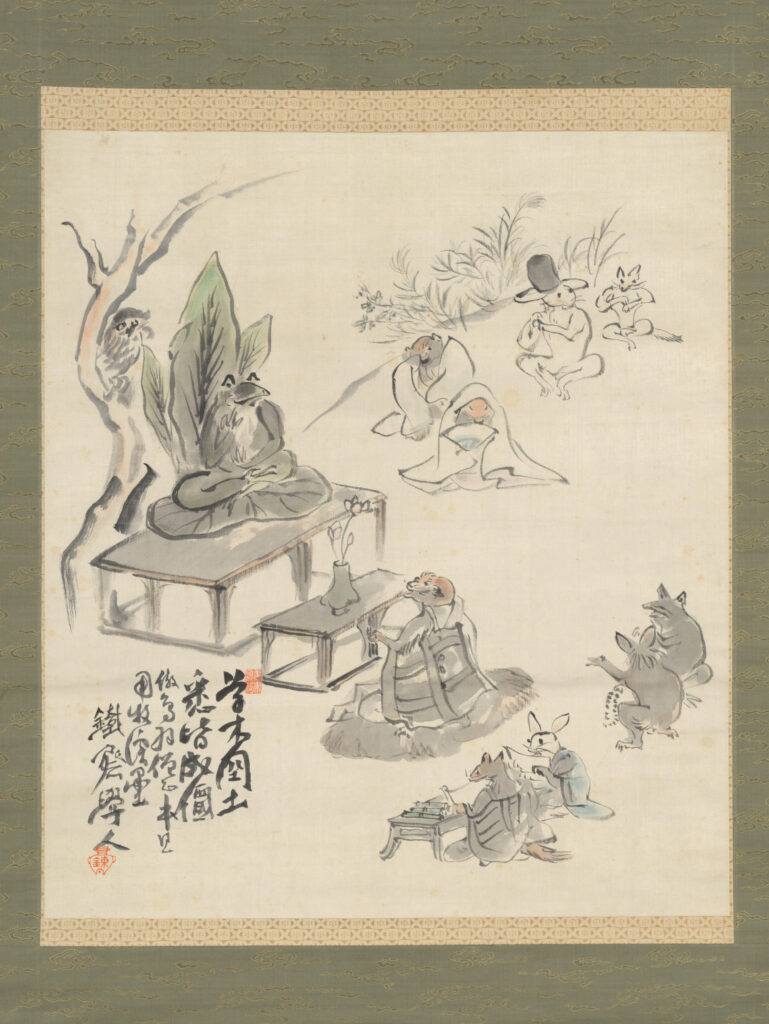
The topics last week were interesting and the folktales led me to look outward to what was happening to Japan during this period. There are many differences in how literature and art had evolved. My favorite piece of art was the Frolicking Animals scroll within the Tale of Genji. The reason why I was intrigued by it was due to its idyllic nature. While we have seen other pieces, which featured these themes (about court life, and its chill/pleasant atmosphere), I have never seen this done with animals. It was captivating to see as they are personified and do daily chores and play. There is a calm vibe that embodies the piece, lending itself to feeling domestic and peaceful. In one of the articles, there was a depiction of animals that is very soft, and they take on human qualities in order to help better emote. The rabbits, frogs, and other animals all coexist with one another, and the different species all denote their social class. The animals which are in play imply that they are of higher status as they do not have to work, and the animals carrying heavy loads, vegetables, and farming equipment are of the lower class who are hard at work. Yet even though they are meant to show the differences in social class, they all carry the same ideal and blissful appearance. This piece was created sometime during the beginning of the Kamakura period. Due to the period in which it was created, I was wondering if this piece could possibly be used as a political tool in creating peace and stability between the separate social classes. Art has been a notorious tool in order to spread propaganda (i mean in broad terms, not denoting the negative nature). The leadership within the Heian period I think was quite messy: Masakado’s rebellion, Taira No Kiyomroi and his authoritarian leadership, the Genpei wars and retaliation to Kiyomori, Minamoto Yoritomo’s succession, Taira no Makasado, etc. As the Heian period came to a close and the Kamakura period emerged, it’s not such a far stretch to believe that this art piece was an attempt to reconcile the instability which troubled Heian. To leave the political and social strain behind in the old period, and to create a more peaceful and harmonious period 😀 The animal’s ability to find a way to coexist with one another sends the message to citizens that there is a way to find stability in life, which did not exist during the Heian period.
[i found this art piece that was inspired by the frolicking animal scroll which i thought was cute]
Friday, Karl. “The Dawn of the Samurai.” In Japan Emerging: Premodern History to 1850, edited by Karl F. Friday, 178-188. New York, NY: Routledge, 2018.
“Scrolls of the Frolicking Animals”, attributed to Toba (1053–1140).
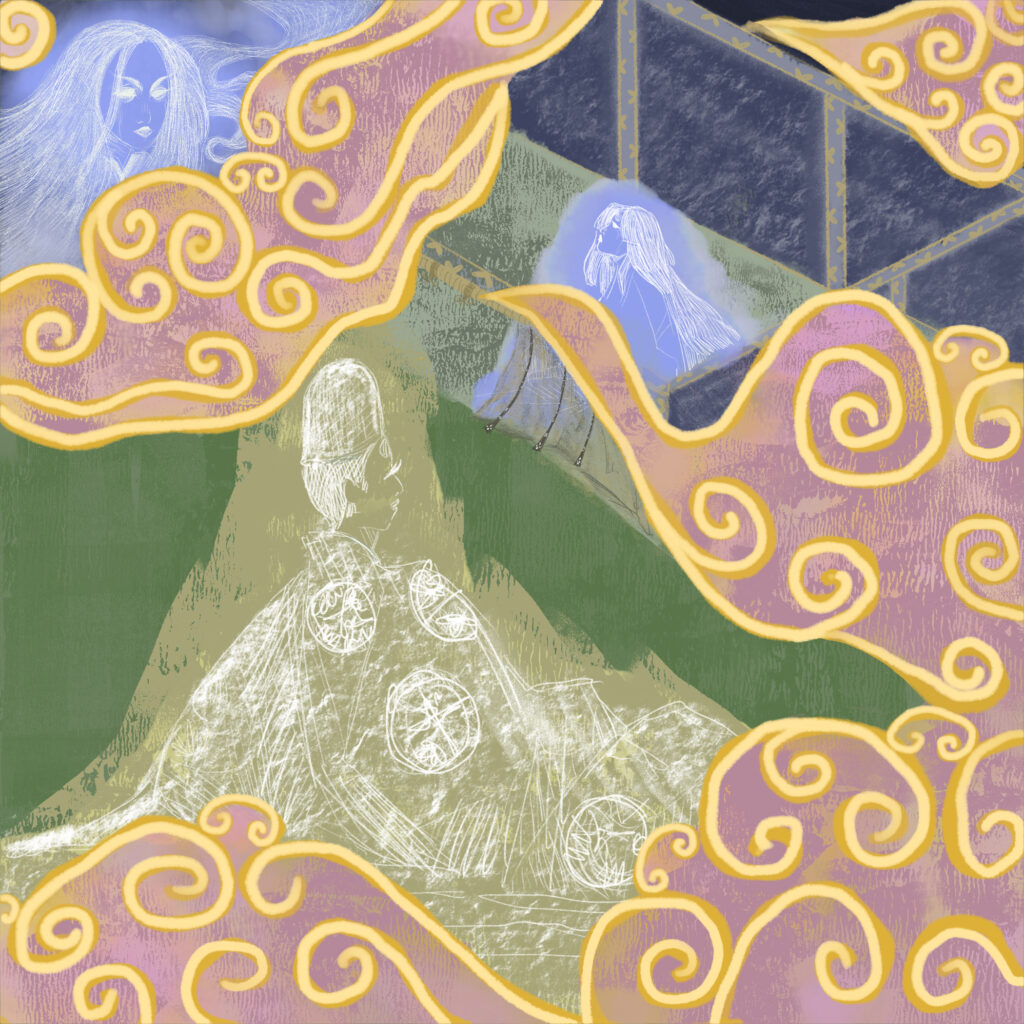
For my show and tell assignment, I decided to create an art piece from the week’s readings. This is my depiction of how the story of Aoi and Lady Rokujō’s Spirit in the Tale of Genji looks like in my head. I incorporated clouds like how most traditional Japanese art pieces look of the Tale of Genji, where they would separate scenes or stories with the clouds. I chose to separate the three different figures from this story: Aoi, Genji, and Lady Rokujō’s spirit. The spirit is in the top left of my drawing, Genji is looking in through the curtain at the bottom, and Aoi (as i interpreted) is being possessed by the spirit. In this story, there are themes of jealousy and its destructive power, as a lover of Genji becomes so in love with him, that it manifested into a spirit full of wrath. The chapter introduces Lady Rokujō, Genji’s mistress, who becomes increasingly jealous of his wife Aoi, particularly after discovering that she is pregnant with Genji’s child. Lady Rokujō’s jealousy turns into an obsession, and she begins to experience supernatural phenomena, such as strange illnesses and ghostly apparitions. Lady Rokujō’s was jealous and becomes fixated on Aoi and sees her as a rival for Genji’s love and attention. The ‘supernatural’ events that occur throughout the chapter serve to heighten the drama and create an eerie and unsettling atmosphere, which i wanted to portray in this drawing. I chose to draw the clouds, referencing the japanese art style of clouds, or ‘Kumo’. The Japanese were influenced by China and their way of portraying the color and shape of the clouds. In ancient China, it was believed that clouds correlated with gods or spirits and a source of all universal things. Japan started to create various designs of clouds, which was directed by how the Chinese drew them. Clouds affect weather with movement, so I wanted to show this type of particular movement, like in traditional japanese art pieces. I reflected the japanese “yamato-e” style, like used in the Take of Genji, with outlines and think opaque colors: the pink (which is a shade of red that represents luck, like clouds). I have detailed line work with this drawing, like during the Heian period and used the clouds as a transition for the different characters I drew; the clouds I lined in yellow, as most japanese art pieces have clouds painted in a shade of yellow. I wanted to emphasize my art piece with bright color choices and having the spirit and Aoi with a shade of purple to draw the viewers attention to them, as they are the overall feature of the story, along with the white line work, truly representing the depiction of the spirit and possession.
Helen Craig McCullough, translator. Genji & Heike: Selections from The Tale of Genji and The Tale of Heike, Stanford: Stanford University Press, 1994.
During the Heian period, Murasaki Shikibu, wrote the Tale of Genji. In this traditional Japanese novel, the author explains her views with fiction romance literature. The type of story like the tale of Genji helped the readers of its time to get a sense of what honest love is with both good and bad parts of it. Writing like this keeps the reader engaged and invested in the story as a whole, not even just the romantic parts; it corresponds to Buddhahood and earthly lust (bodai and bonnō), as stated in “Murasaki Shikibu: On the Art of Fiction”, which connects to the buddhist beliefs on enlightenment (bonnō soku bodai). Genji is the son of the emperor and considered very intelligent and talented, making him very popular. In “Kritsubo”, Genji is visited by a woman who has fallen in love with him, but whom he does not reciprocate her feelings. In order to discourage her, he shows her a broom tree outside his window and tells her that he is like the tree (i guess implying that he is dry and dying which is so dramatic). The woman leaves after saying a random poem expressing her sadness. In “Aoi”, which tells the story of the battle of the carriages, Genji’s wife, Lady Aoi, is possessed by a bad spirit that causes her to become ill, while she is currently pregnant. I don’t really know what was going on in this story all that much, but men on horseback were making a ruckus and this spirit also was there. In “Lady Rokujo’s spirit”, Lady Rokujo is one of Genji’s former lovers, who has been consumed by jealousy and cold bitterness oooo and haunts Genji’s wife while she is trying to give birth. I think she then gets possessed by this spirit and it says a depressing poem and leaves again. The baby is born safely and they all say vows, hoping for the good omen of this baby’s birth to stay. The Tale of Genji is a great traditional Japanese fiction novel, with themes of love, jealousy, and power. The characters with complex relationships, and intricate plots have influenced generations of writers and continue to engage readers around the world.
“Murasaki Shikibu: On the Art of Fiction.” In Sources of Japanese Tradition, Volume One: From Earliest Times to 1600. 2nd edition, edited by Ryūsaku Tsunoda, Wm. Theodore De Bary, and Donald Keene, 201-202. New York: Columbia University Press, 2002.
Helen Craig McCullough, translator. Genji & Heike: Selections from The Tale of Genji and The Tale of Heike, Stanford: Stanford University Press, 1994.
Helen Craig McCullough, translator. Genji & Heike: Selections from The Tale of Genji and The Tale of Heike, Stanford: Stanford University Press, 1994.
While reading about the Kokinshū japanese poems, I found the comparison between this and haikus interesting, which is another form of japanese poetry. Kokinshū poems usually consisted of 31 syllables, arranged in a pattern of 5-7-5-7-7, with themes like seasons, love, and mourning. The kokinshū poems were meant to be read aloud, and were often accompanied by music or dance. Haikus are a more recent form of Japanese poetry that consist of 17 syllables arranged in a pattern of 5-7-5, with common themes of nature and seasons. Haikus are more minimalist than kokinshū poems, using simple and direct language describing a specific moment or image, whereas kokinshū poems are more elaborate and literary. Kokinshū poems were written by courtiers and aristocrats and haikus were widespread, written and read by many. Both kokinshū poems and haikus are forms of Japanese poetry that explore similar themes, they differ in terms of structure, style, and accessibility. The earliest Japanese piece of literature written in kana is the Taketori Monogatari. The message that the writer is trying to send to the aristocracy is that they should have noble traits which the aristocrats in the story didn’t have to be respectful of others [kaguya was stalked/spied] to be truthful and never deceive, and to never be greedy. Even the Emperor, Mikado, failed to see Kaguya, and his army was useless, but he still respected her space and only exchanged waka poems. His burning of the elixir of life and the feathered robe of heavenly beings and letter through the burning of these gifts; it can be interpreted that aristocrats should strive to be like Mikado— for he was not greedy like others. But it can also be interpreted that this was a bad omen, cause smoke came from the mountain [active volcano].
Shirane, Haruo, ed. Traditional Japanese Literature : An Anthology, Beginnings to 1600. Abridged ed. Translations from the Asian Classics. New York: Columbia University Press, 2012. http://docs.tdh.bergbuilds.domains/267/hst267-5-1-kokinshi-selection.pdf
Britannica, The Editors of Encyclopaedia. “haiku”. Encyclopedia Britannica, 22 Aug. 2022, https://www.britannica.com/art/haiku. Accessed 19 February 2023.
“The Tale of the Bamboo Cutter” (Taketori monogatari).In Traditional Japanese Literature : An Anthology, Beginnings to 1600. Abridged ed., edited by Haruo Shirane. Translations from the Asian Classics. New York: Columbia University Press, 2012. https://www.japanese-wiki-corpus.org/literature/Taketori%20Monogatari%20(The%20Tale%20of%20the%20Bamboo%20Cutter).html
Nara was similar to China’s capital Chang’an, which was based on canonical Confucian text. It is interesting that Heian’s model deviated from Nara and Chang’an, as it does not have any walls to border off the city. In one of the readings [of State Sponsorship and Control of Buddhism], it explores how religion was used in order to control people. From Emperor Shomu in, the Shoku Nihongi in Rikkokushi III they have erected an “image of Lochana Buddha in gold and copper.” He hoped that others will join in the way to “Buddhahood,” and that all who join must be pure and sincerely pious in order to receive blessings and pay daily homage to the statue. The Emporer is also sympathetic to those who cannot pay, and have nothing to offer, writing that the officials and authorities should not bother them; Buddhism was used in order to control the people. It instilled social values [being pure and pious], and also accepted those that were impoverished. It would help the Emperor to be on good terms with the people, and to keep himself and the state in control while feigning equality. The people and the Emporer are only equal in their paths to Enlightenment, but the Emperor still has control over the people. I did not know how intricate Buddhism was. I was aware that there were separate sects, but the division between Nara and Heian Buddhism, with Kukai and Tendai and Shingon, helped me to understand the divisions of Buddhism further. I was vaguely aware of the four noble truths (suffering, the origins of suffering, the end of suffering, and the truth of the path). We also got to see the Heian mandalas, and while I knew that mandalas were a traditional Indian art form, it was cool to see how Buddhism was able to mesh into traditional Japanese culture/art/beliefs. With the mandalas, it is clear that it stays true to Indian mandalas because it retains a geometric form and symmetry. But unlike the figures in Indian mandalas, the figures drawn in Japanese mandalas draw from traditional practices. The figures relate more to typical Japanese art, showing how they have been able to utilize their own practices in Buddhism. Seeing the different Buddhist temples were also impressive. It shows how Japan was able to embrace the religion, and still be able to use their own aspects of culture and merge everything together.
Sources of Japanese Tradition, Volume One: From Earliest Times to 1600 2nd edition, edited by William Th. de Bary. New York: Columbia University Press, 2002. http://docs.tdh.bergbuilds.domains/267/hst267-4-1-narra_buddhism.pdf
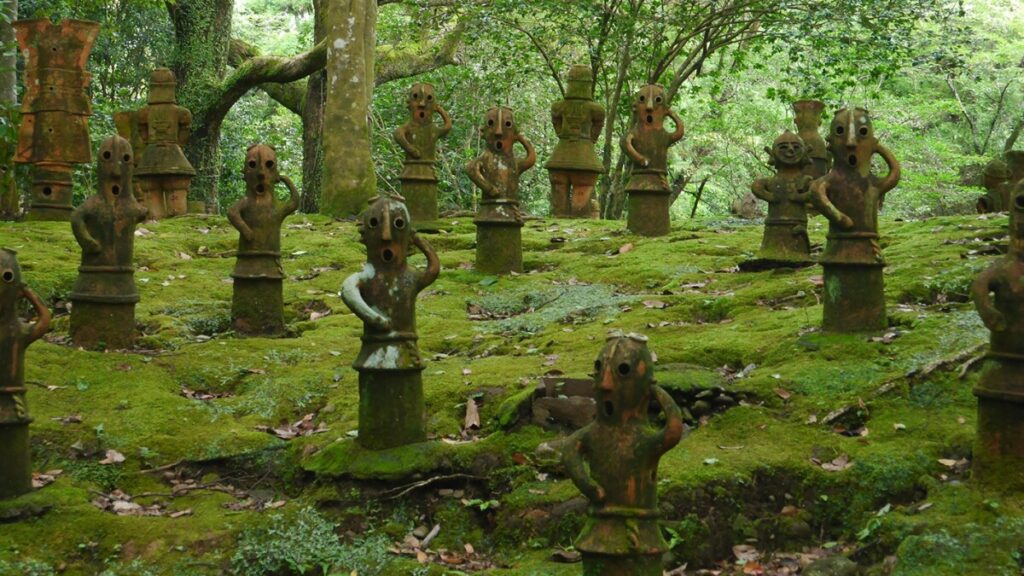
The Meiji Restoration of 1868 marked a significant turning point in Japanese history. The Japanese wanted to return to their founding myths and the creation of their nation, which was characterized by the restoration of imperial power and the eventual rise of imperialism (myths and art continue to influence Japanese culture to this day). One of the oldest myths in Japanese history is the story of the goddess Amaterasu, who was locked in a cave and symbolizes the entrenchment of the Japanese people in their shrines (those who were dedicated to the Kami, the spirits and deities of the Shinto religion). Shinto, which did not have a name until outside forces brought attention to it, can be traced back for centuries. Another important aspect of Japanese history during this time was the Kofun period, when Queen Himiko ruled, prior to the beginning of the Kofun era. During this time, Japan also saw the importation of mirrors, swords, and metal from China, as well as the creation of Haniwa, clay figures that were used in burial rituals. These figures were used in burial rituals and were placed around the perimeter of burial mounds to protect and honor the deceased. The cultural exchanges continued to shape and influence Japanese culture for centuries to come. During the Sui and Tang dynasties in China, there was significant influence and exchange between the two nations, introducing Buddhism, Chinese writing and culture, and the Chinese also established diplomatic and trade relationships with the Japanese court. The exchanging of ideas/knowledge between China and Japan during the Sui and Tang dynasties had a lasting impact on Japanese history and helped to shape the development of Japanese society and culture. The Seventeen Article Constitution of Prince Shōtoku (Shōtoku Oath) was a political and ethical document created in 604 AD in Japan, which was a code of conduct for the ruling class and seen an important development of Japan’s political framework; it emphasized the importance of education, ethical behavior, and the promotion of Buddhism, and served as a model for future Japanese constitutions.
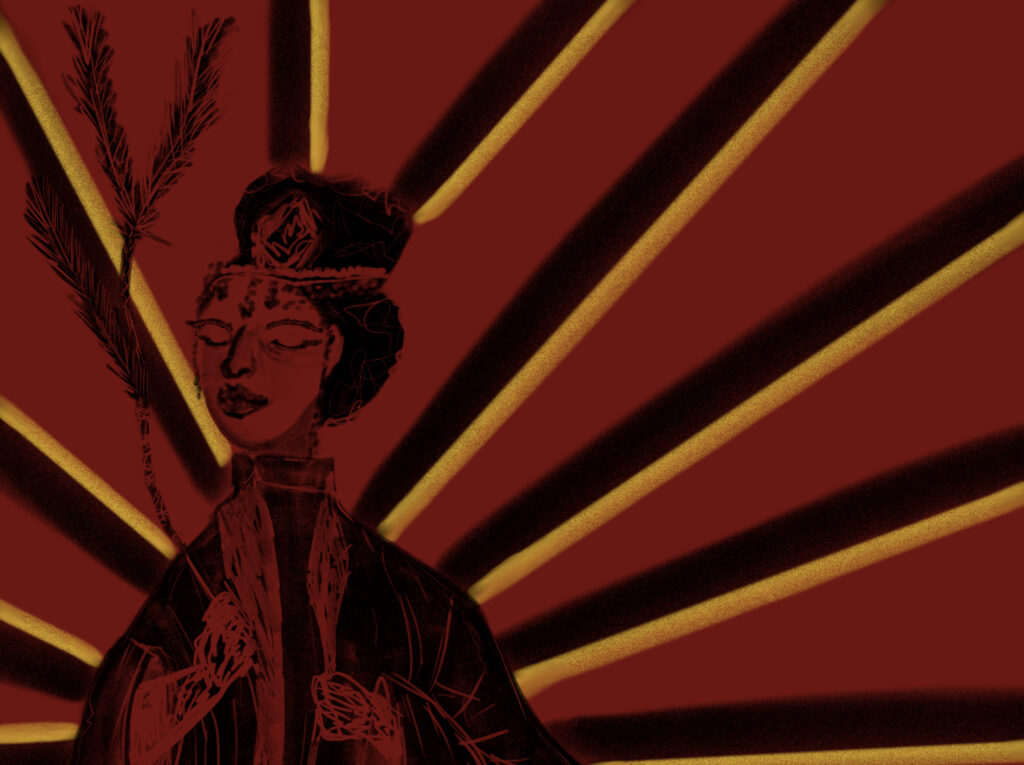
For my show and tell topic, I wanted to create an art piece of Queen Himiko, who was a legendary ruler of Yamato, Japan, and a divine descendant of the Shinto sun goddess, Amaterasu. This powerful woman was known as a shaman/high priestess and was revered by her people for her leadership and spiritual prowess. In my art piece, I have Queen Himiko as the central focus, surrounded by sun rays that symbolize her divine heritage as a descendant of Amaterasu. I chose to have her standing tall and proud, holding a branch from a Matsu tree, which is a powerful symbol in Japanese culture. The Matsu tree branch represents strength, courage, perseverance, and longevity, which I believe are all qualities that describe Queen Himiko. Queen Himiko was the first legendary woman to rule Japan, and her reign was characterized by her power and influence. She spent much of her time in her fortress, much like how Amaterasu is said to have “shut herself away in a cave”. This, I believe, is an interesting parallel between these two powerful women and highlights the strength and resolve that Queen Himiko possessed. The Wei Dynasty in China respected Queen Himiko and saw her as the ruler of all of Japan. Emperor Wei, emperor of China, once said, “You live so far away across the sea; yet you have sent an embassy with tribute. Your loyalty and filial piety we appreciate exceedingly. We confer upon, therefore, the title “Queen of Wa, Friendly to Wei””. This statement shows the respect that Queen Himiko commanded from other nations, and her ability to form strong relationships and alliances with those she encountered. My art piece depicts the legendary and powerful Queen Himiko. With her being surrounded by sun rays and holding a Matsu tree branch, I wanted to capture her divine heritage, her power and influence as the first legendary woman to rule Japan, and her relationship with other nations, particularly the Wei Dynasty in China. Through Queen Himiko being the center focus and holding a Matsu branch, this piece symbolizes her strength, courage, perseverance, and longevity, and her legacy that continues to inspire and influence people today.
i enjoyed learning about the origins of Japan, which are traced back to the Yayoi period, where there was a significant influence of immigration from Korea. The country was inhabited with hunter-gatherers for thousands of years, before a unique surge of culture took place. During the Paleolithic era, the upper west influenced northeastern Asia, shaping the diet, tools, pottery, and trading practices in that region. The Ryukyu region in S. Japan holds the oldest evidence of human bones/tools, while bones have also been discovered under volcanoes in Kyushu. The Jomon period saw the spread of woodlands and a warmer climate, leading to an increase in food and animals to hunt. N. Japan relied heavily on river salmon and developed cooking pots, ceramic containers to store food, pit houses, and communal longhouses for storage; burnished pottery, ceramic teapots, and pottery drums were used in feasts and celebrations. During this period, there were more communities and social influences, which led to the introduction of ancient fishing and rice paddy fields by Korean immigrants in S. Japan. This resulted in competition between families, given the different graves and crops found in that region. The Yayoi period involved a majority of Japanese and Korean families who spread quickly throughout Japan. The peak of the Yayoi period was in Yoshinogini, which may have been the capital. The Kofun period saw the rise of aristocrats, who shared their ways of control and gaining wealth through the housing and goods they possessed. This period was marked by combat and housing completions, estimate from the findings of war horses, armor, and weapons. The Chinese concepts of court hierarchy with official ranks and governors, road systems, population registers, and taxing, inspired the social and political system of Japan. In 646 CE, the Yamato court edict was issued and this eventually evolved into a centralized imperial state by 710 CE, during the Nihon period.
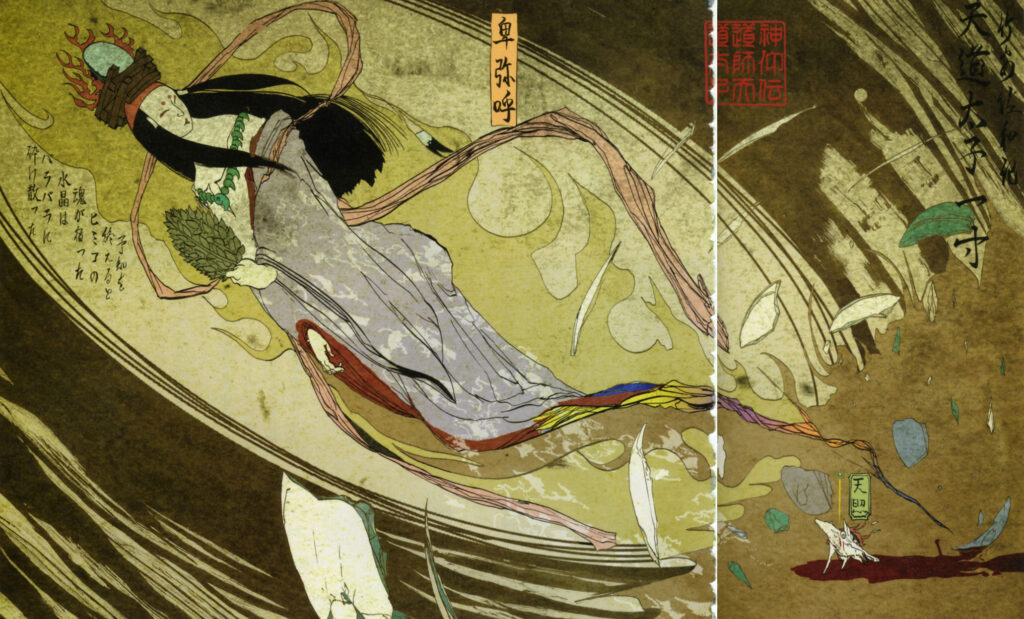
To understand and learn how to differentiate well-written and reliable articles and source material, the class was divided into various groups that had different articles about Queen Himiko. I learned and found very interesting how Queen Himiko was a legendary figure in ancient Japan who was believed to be a divine descendant of the Shinto sun goddess, Amaterasu. She was the ruler of the Yamato territory, one of the 100+ kingdoms in Japan, and was considered the most powerful. She was referred to as the “ruler of all Japan”, according to the Wa in China and had a good relationship with the Wei dynasty. Her rule was recorded in Chinese sources such as the Wei Chih history book, and it was believed that she was chosen by the people to rule after 80 years of warfare and uprisings. It was said that she lived a secluded life, serving as a high priestess and shaman, and was attended by 1000 women in her fortress. Her legacy in Japan continues to live on through references in tarot cards, manga, pageants, and as a well-known historical figure in schools. I think people who encounter Queen Himiko first in this context perceive her honestly as a badass ruler, but without learning her historical impact and significance (for example learning about her through tarot cards) it is a completely different interpretation because of how over-glorified she is (I do not mean this negatively). The exact location of her rule and the details of her ruling and burial are debated, but her tomb is believed to be a 150 meter mound with 100 slave sacrifices and dates back to the Yayoi through to the Kofun period (250-538 CE). Although the article was extremely short and vague, it was a good source in order to get a quick introduction to who Queen Himiko was.
I added more to this post, responding to this comment: “How do you think people who encounter Queen Himiko first in this context perceive her? We can learn all these great and inspiring things about her but how do you think that is different from say tarot cards?”. Through rewriting this, I learned to think about different perspectives on understanding influential figures that are adapted into pop culture and media. 👍